









Spring 2024
The Invisible Woman
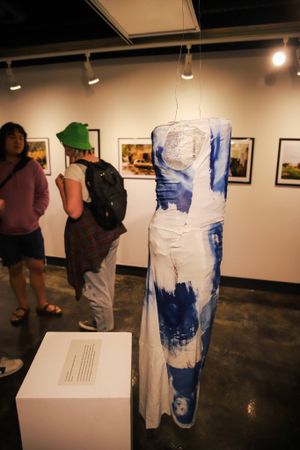
“The Invisible Woman” Started as an experiment. Originally made out of cotton t-shirts, the dress came to be by accident. After seeing the prints she made, Cyan looked at the faces of the women on her fabric and decided then to create a work dedicated to all of the women lost in history. “The Invisible Woman” is a physical representation of women’s achievements buried by their male counterparts in the workplace, the home, and textbooks alike.
At its core, "The Invisible Woman" is a critique of how society has historically ignored or actively suppressed the accomplishments of women, often overshadowing them with the achievements of their male counterparts. This phenomenon is pervasive across all levels of society. In the workplace, for instance, women’s contributions have been downplayed or undervalued, despite the fact that many of the foundational ideas and innovations came from female thinkers, scientists, and leaders. Similarly, in the home, women’s labor—whether domestic or emotional—has often been invisible, regarded as secondary or unimportant compared to that of men.
Furthermore, "The Invisible Woman" serves as a commentary on the way textbooks and historical narratives are structured. History has often been written from a male-centric perspective, with women’s roles in society either minimized or entirely omitted. The dress itself, a symbol of these buried stories, is a physical manifestation of these forgotten women who have contributed so much yet received little recognition or credit.
The use of cotton t-shirts in creating this work is particularly significant, as the fabric itself represents an everyday, humble material. Cotton is something familiar, yet when transformed into something as creative and deliberate as "The Invisible Woman," it underscores the idea that these invisible women’s stories are worthy of being seen and remembered.
In this way, the cyan dress is both a tribute and a call to action, urging us to rethink how we recognize and celebrate the achievements of women. It challenges viewers to reflect on the ways in which gender has shaped historical narratives and encourages a more inclusive approach to telling the stories of the past, where women’s achievements are given the visibility and recognition they deserve.